
Art College Crash Course, Lesson 13: The Animator's Survival Kit
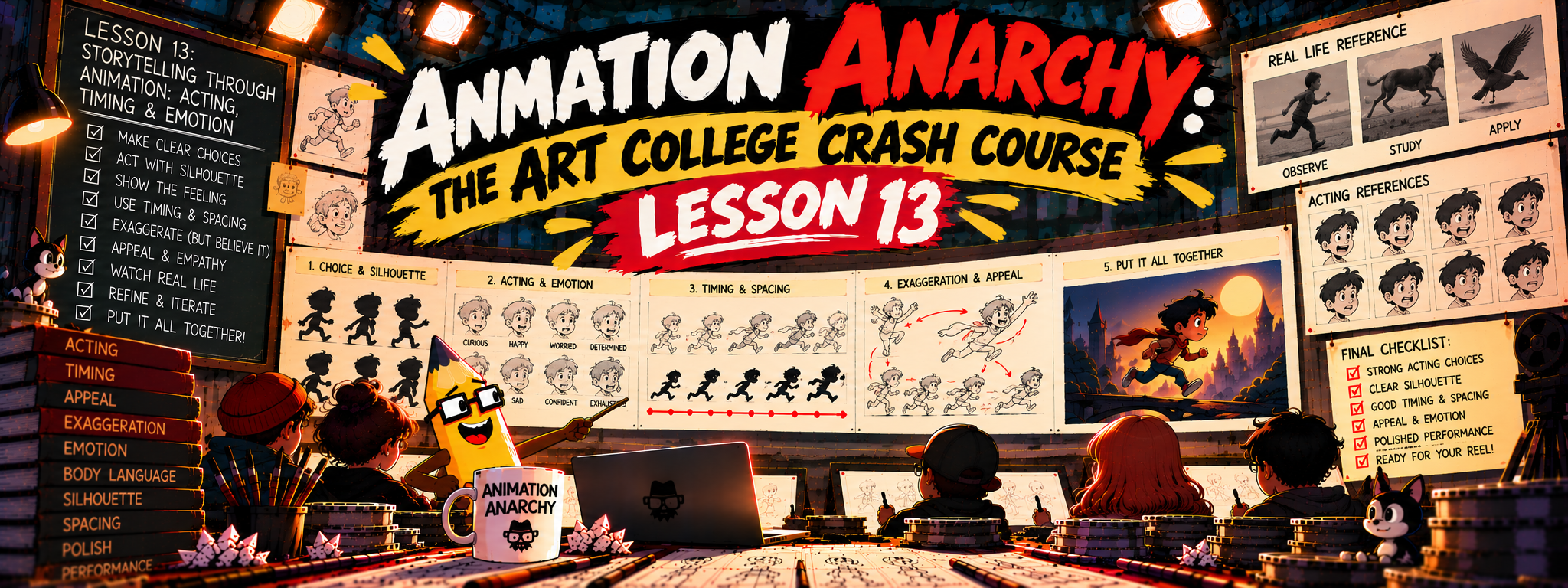
Or: the book that follows every animator around forever.
Every animator ends up owning one book: The Animator's Survival Kit by Richard Williams.
REAL: Williams was an Oscar-winning animator who directed the animation in Who Framed Roger Rabbit (1988). His book, first published in 2001, is packed with hundreds of pages of drawings showing how things move: walks, runs, jumps, timing, acting.
It's the best animation book ever written. It's also humbling.
The five stages of reading it
"This looks easy." The first pages cover bouncing balls and anticipation. No problem.
"Wait, what?" You reach the walk section. There are a lot of drawings for one step.
"I'll skip ahead." You jump to the acting chapters, then realize you still can't make a character walk, and go back.
"My walk looks like a wobbly puppet." Every animator's first walk does.
"Okay. Let's do this." The book becomes your best friend.
Lesson A: Walk cycles
A walk is harder than it looks. Every step needs weight, balance and timing.
The four key poses: 1. Contact: the front heel touches the ground. 2. Down: the body sinks as weight lands on the front leg. 3. Passing: the back leg swings past the standing leg. 4. Up: the body rises as it pushes off.
Tips: Use video reference of real walking. Get a plain walk working before you add personality. Common mistake: a character who looks like they're sliding on ice, because the feet don't stick to the ground.
Lesson B: Timing
Timing decides whether motion feels slow and heavy, fast and light, or just right.
Tips: More drawings slow things down. Fewer speed things up. Watch how things move in real life and count. Common mistake: a jump that lands instantly, like gravity took the day off.
Lesson C: Acting over perfection
Smooth movement isn't enough. The audience needs to know what the character is thinking.
Tips: Ask "What is my character thinking right now?" Make strong, clear poses. Even a small head tilt says a lot. Common mistake: a technically perfect scene where the character's face shows nothing.
How to use the book
Use it as a reference, not a novel. Look things up when you need them.
Start with walks, timing and weight.
Copy the drawings and figure out why they work.
Come back often. You'll notice new things every time.
Try this
Animate a simple walk using just the four key poses. Use stick figures. Flip through them. Then add one in-between drawing between each pose and see how much smoother it gets.
Up next
Lesson 14: Lip Sync. How to make your character talk without looking like a nutcracker.
What's the hardest thing you've tried to animate? Tell us in the comments.
The revolution will not be graded.
New episodes drop on YouTube first. Subscribe to Mr. Bray Labs so you never miss one.
