
Cartoon Conspiracy Theories, Rated – Part 2
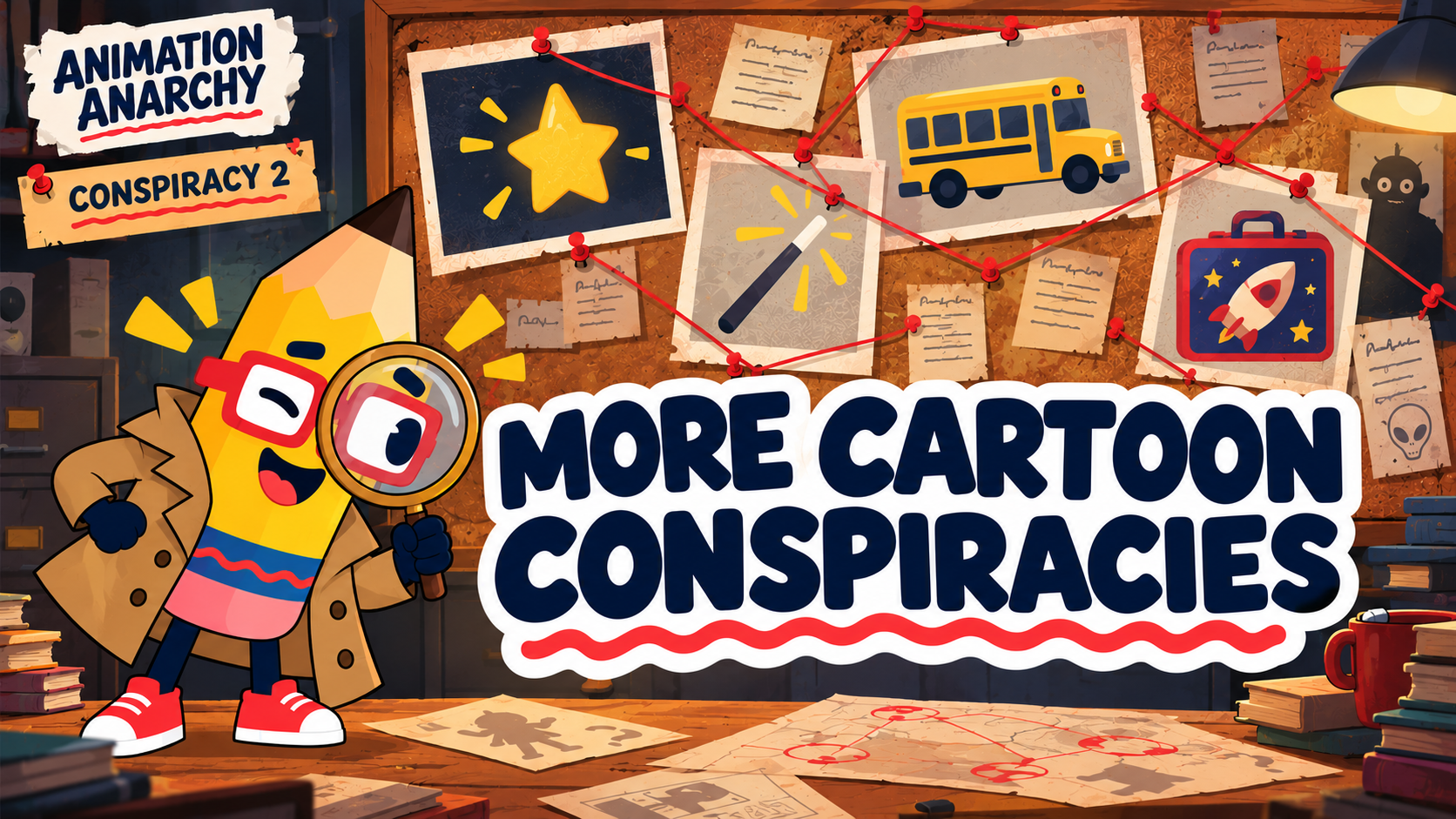
The Smurfs, Timmy Turner, the Magic School Bus, Looney Tunes and Winnie the Pooh go on trial.
You survived Part 1. Scooby-Doo's economy, the Eds in limbo, and Dexter's suspicious basement. Congratulations. Now we go deeper.
Same rules as before:
REAL: it happened, and you can look it up.
RUMOR: fans say it, but the evidence is thin.
ANARCHY: I made it up because it's funny.
1. The Smurf village is a perfectly planned experiment
The theory: Everyone in the village dresses the same. Everyone has exactly one job, and their name is the job: Handy, Brainy, Baker. There's one leader in a different color hat. Nobody leaves. That's not a village. That's a lab study about what happens when you organize a whole society around jobs.
RUMOR. Fans have argued about what the Smurf village "means" for decades. The creator never confirmed any of it.
REAL: the Smurfs were created by Belgian cartoonist Peyo in 1958, as side characters in a comic called Johan and Peewit. They were so popular they took over.
ANARCHY: Lazy Smurf is the only one who figured out the experiment, and he's choosing to nap through it.
Plausibility: 6 out of 10. I now look at Papa Smurf's red hat with suspicion.
2. Timmy Turner's fairies are how he copes
The theory: Cosmo and Wanda show up because Timmy is lonely and miserable. Mean babysitter, distracted parents. Their wishes never really fix anything, and the rules always get in the way. Maybe the fairies are what a kid's imagination builds to get through a hard time.
RUMOR, but the show leans into it. REAL: in the 2004 special Channel Chasers, we see a grown-up Timmy who has lost his fairies and forgotten them, because kids lose their fairies when they grow up.
That's not dark. That's the most honest thing a cartoon can say: the things that help us as kids don't always come with us, and that's okay.
Plausibility: 7 out of 10. Feelings: fully damaged.
3. The Magic School Bus is smarter than Ms. Frizzle
The theory: The bus shrinks, flies, turns into a submarine, and goes inside a human body. Nobody at the school asks a single question. What if Ms. Frizzle isn't in charge? What if the bus is a super-intelligent machine that decided these kids are going to learn science whether they like it or not?
ANARCHY. Pure fun.
REAL: the show was based on the book series by Joanna Cole and Bruce Degen, and the TV version was produced with real science advisers. That's why the facts hold up even when the bus is the size of a germ.
Plausibility: 10 out of 10. The bus knows. The bus always knew.
4. Looney Tunes characters are a super-soldier program that escaped
The theory: Bugs Bunny never loses. Daffy's beak falls off and he just puts it back. Wile E. Coyote falls off a cliff every day and keeps showing up for work. These aren't animals. They're the world's most durable failed experiment.
ANARCHY. But it explains a lot.
REAL: the cartoon "rules" are real. Animators at Warner Bros. figured out that audiences laugh hardest when characters bounce back instantly. Squash, stretch, recover. Pain without consequences is what makes slapstick funny instead of upsetting.
Plausibility: 9 out of 10. Wile E. Coyote's insurance company: 0 out of 10.
5. Everyone in the Hundred Acre Wood is a personality type
The theory: Pooh loves honey a little too much. Piglet worries about everything. Eeyore expects the worst. Rabbit needs everything organized. Tigger cannot sit still. Some fans say A.A. Milne wasn't writing a kids' book. He was writing a field guide to people.
REAL, sort of: in 2000, a group of doctors published a tongue-in-cheek article in the Canadian Medical Association Journal called "Pathology in the Hundred Acre Wood," jokingly "diagnosing" every character. It was satire, and it went viral before going viral was a thing.
Here's where the educator in me raises a hand. Diagnosing cartoon characters is a fun game, but real conditions aren't punchlines. What Milne actually captured is better than a diagnosis: a group of very different friends who keep showing up for each other. Eeyore never gets fixed. His friends invite him anyway. That's the lesson.
Plausibility: 8 out of 10. Number of times I've been Eeyore this week: several.
What these theories teach us
The best cartoons are built on clear, simple personalities. One trait, pushed far. That's why fans can map them onto real life so easily. It's also why you remember them decades later.
Your turn
Which theory got you? Which did I rate too low? Tell me in the comments. In Part 3, we go completely off the rails.
New episodes drop on YouTube first. Subscribe to Mr. Bray Labs so you never miss one.
