
Art College Crash Course, Lesson 17: Run Cycles
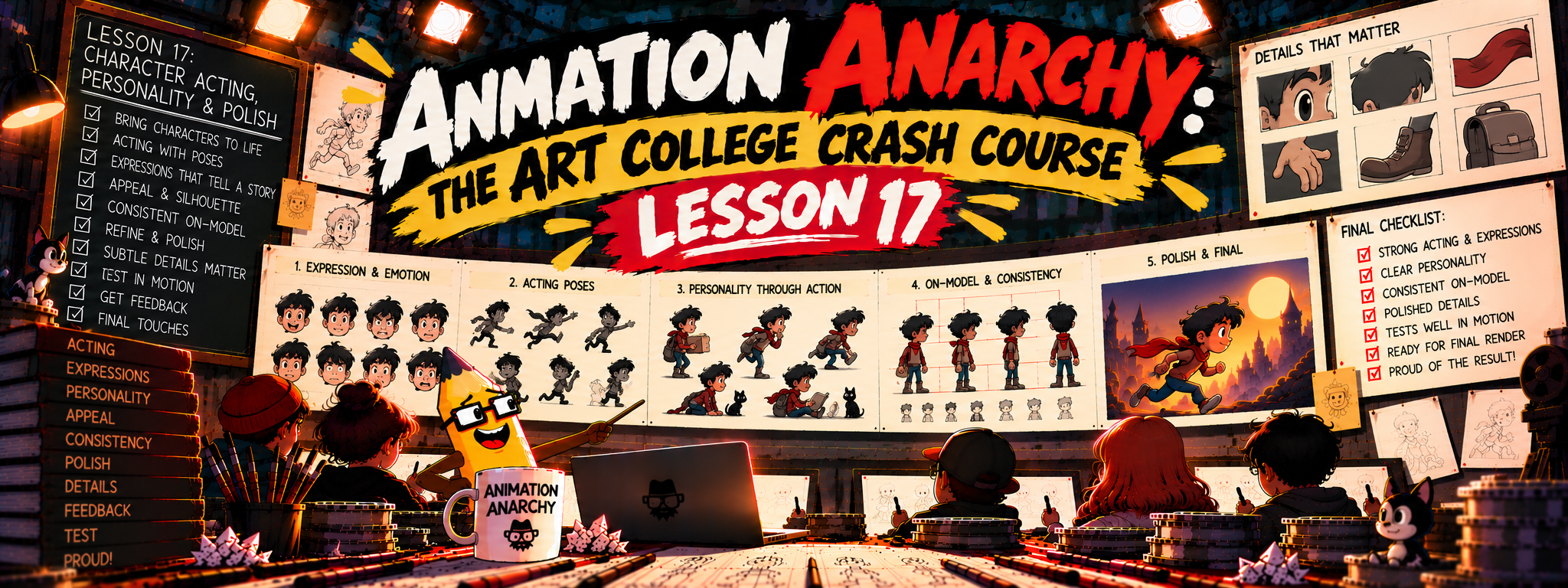
Or: the walk cycle's faster, trickier sibling.
You finally made a good walk cycle. Great. Now make it run.
Why runs are harder than walks
Less time. A walk cycle might take 12 to 16 frames per step. A run often takes 6 to 8. Fewer drawings means every mistake shows.
Flying. In a walk, one foot is always on the ground. In a run, there's a moment when both feet are in the air.
More reaction. Arms pump harder, the body leans forward and the head bobs. Leave that out and the run looks stiff.
Too slow? It looks like speed-walking. Too stiff? It looks glitchy. Too smooth? It looks like jogging in place.
The four main poses
1. Contact. One foot strikes the ground, the other leg stretches behind. Arms at their biggest swing. Common mistake: the foot barely touches, and the character floats.
2. Down. The lowest point. The knee bends to absorb the landing, the body sinks. Common mistake: a stiff landing with no give.
3. Passing. The back leg swings forward, the knee lifts, the arms switch. Common mistake: the character slows down here and it turns into a power-walk.
4. Up (the flight). Both feet leave the ground. The body is at its highest. Common mistake: the character never really leaves the ground and just glides.
Common mistakes and fixes
Looks like speed-walking: make the flying moment clear.
Floppy like a rag doll: keep the limbs on clean arcs.
Awkward arms: arms pump opposite the legs, bent at the elbows.
Too floaty: add a stronger impact on contact and down.
Follows the rules but feels off: adjust the timing.
Make it natural
Lean the body forward. The faster the run, the bigger the lean.
Exaggerate the bounce and leg stretch first, then pull back.
Check every frame's silhouette.
Film yourself running (somewhere safe) and watch it in slow motion.
Try this
Animate one run cycle with the four poses per step. Then make two versions: a sprint (more lean, bigger stride) and a happy skip-run (more bounce). Compare.
Up next
Lesson 18: Action Scenes. How to make a punch look powerful in a cartoon.
What's the best cartoon run you've ever seen? Tell us in the comments.
The revolution will not be graded.
New episodes drop on YouTube first. Subscribe to Mr. Bray Labs so you never miss one.
